

Engineered Fasteners for Automotive Manufacturing

In automotive manufacturing, every component contributes to vehicle performance, safety, reliability, and cost efficiency. Engineered fasteners may represent a small part of the overall assembly, but they can have a significant impact on how vehicles are designed, manufactured, and maintained.
Fasteners can constitute up to 50% of a car’s Bill of Materials (BoM), while typically accounting for only a small percentage of the total build cost. Despite their prevalence, the importance of engineered fasteners in automotive manufacturing is often underestimated.
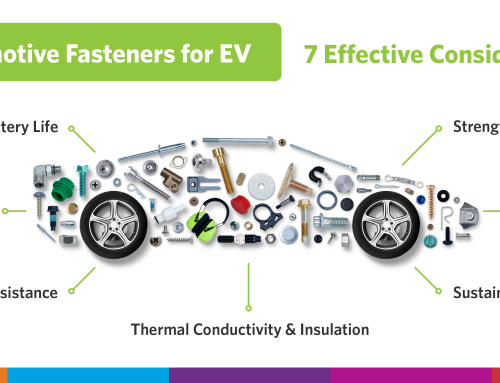
More than a standard nut, bolt, or screw, an engineered fastener is a precision-designed solution developed to meet specific application requirements. These can include strength, weight, material compatibility, vibration resistance, corrosion protection, thermal performance, and assembly efficiency.
How Do Engineered Fasteners Influence the Final Vehicle?
In automotive manufacturing, the right fastening solution can contribute to design optimization, enhanced performance, increased safety and reliability, greater cost efficiency, innovation, and weight reduction.
This article explores how engineering fasteners for specific automotive applications can help manufacturers solve design challenges, improve assembly performance, and support long-term vehicle quality.
Automotive Manufacturing Design Optimization & Enhanced Performance through Engineered Fasteners
Fastener engineers can help automotive manufacturers identify opportunities to optimize performance, reduce weight, and meet evolving technical requirements. For example, fastener geometry can be engineered to minimize vehicle weight while still meeting strength, tolerance, and assembly requirements.
Material selection also plays an important role. In electric vehicle applications, materials such as aluminum may be considered to help dissipate heat buildup, which can affect battery performance, durability, and safety. By engineering fasteners around application-specific needs, manufacturers can address thermal performance, material compatibility, corrosion resistance, and assembly efficiency earlier in the design process.
Engineered fasteners can also be designed for automated assembly environments to improve production efficiency, repeatability, and consistency. At Optimas, application engineers collaborate with manufacturers to design the right engineered fastener for specific performance, assembly, and production needs. As a full-service partner, Optimas can also support production through manufacturing facilities in the Americas that specialize in cold forging.
How Engineered Fasteners Increase Safety & Reliability
Automotive fasteners must do more than hold components together. They must meet tight tolerance demands while supporting safety, durability, and reliability throughout the life of the vehicle. In demanding applications, standard fasteners may not meet the full range of design, assembly, performance, and safety requirements.
For example, a banjo bolt used in a wheel application can bear loads between 65–90% of its yield strength, helping prevent loosening, shearing, or failure in use. In high-demand applications like these, engineered fasteners can provide a more precise solution by accounting for factors such as load, torque performance, vibration resistance, material strength, and operating conditions.
By evaluating component design and assembly conditions, fastener engineers can develop custom solutions that help increase reliability, enhance safety, and optimize assembly performance.
Fastener Engineers Can Help Manufacturers Efficiency Up
Engineering fasteners for a specific application can also help reduce costs across the product lifecycle. By involving fastener engineers early in the design process, automotive manufacturers can identify opportunities to augment performance, simplify assembly, lower material usage, minimize rework, and prevent costly downstream production issues.
Early design changes are typically easier and more cost-effective to implement than those made after a vehicle or component is already in production or in the market. By incorporating engineered fastener expertise from the outset, automotive manufacturers can improve both cost efficiency and product performance over time.
For more details on how fasteners can impact engineering priorities, explore Optimas’ solutions for the automotive and EV industry.

For more details on how fasteners can impact engineering requirements, like lightweighting, watch our latest webinar with Automotive News here.
Drive Innovation with Quality Engineered Fasteners
Innovation continues to shape automotive manufacturing, from electric vehicle design and lightweighting to new materials, advanced coatings, and increasingly complex assembly demands. Engineered fasteners can help manufacturers adapt to these evolving needs by addressing unique performance, environmental, and production challenges.
Advancements in fastener materials, coatings, and manufacturing techniques enable solutions designed for sub-zero temperatures, high-stress environments, corrosion exposure, thermal demands, and precision assembly. Secondary operations such as turning, grinding, and shaving can also help create fasteners that meet precise application requirements.
Fastener engineers can also recommend coating systems based on corrosion protection, lubricity, UV resistance, operating temperature range, and other performance considerations. Together, these capabilities make engineered fasteners an important contributor to automotive innovation, performance, and long-term product differentiation.
NEWS: Optimas Solutions has completed further significant investment to its UK manufacturing facility, in Droitwich at their Barton Cold Form plant, with the addition of a MV-S NewGen EDM Machine. Click here to read about the machine’s capabilities and benefits to Optimas’ UK manufacturing.
Partner with Optimas for World-Class Engineered Fasteners
Optimas provides engineering services for automotive OEMs and manufacturers seeking engineered fasteners designed around specific performance, production, and assembly requirements. Our fastener engineers can support standalone projects or collaborate directly with OEM engineering teams throughout product development, innovation, scale-up, and mass production.
By combining fastener engineering expertise with in-house manufacturing capabilities, Optimas helps customers improve quality, performance, cost efficiency, and production reliability. In one example, Optimas partnered with a global manufacturer to redesign a component that eliminated downtime and delivered $120,000 in annual cost savings without sacrificing performance.
Contact Optimas to learn how our team can help develop engineered fastener solutions for your automotive applications.


 English
 Español de México
 Español
 简体中文
 香港中文
 Français
 Türkçe
 Deutsch
 Italiano
 日本語
 English (UK)
 Français du Canada